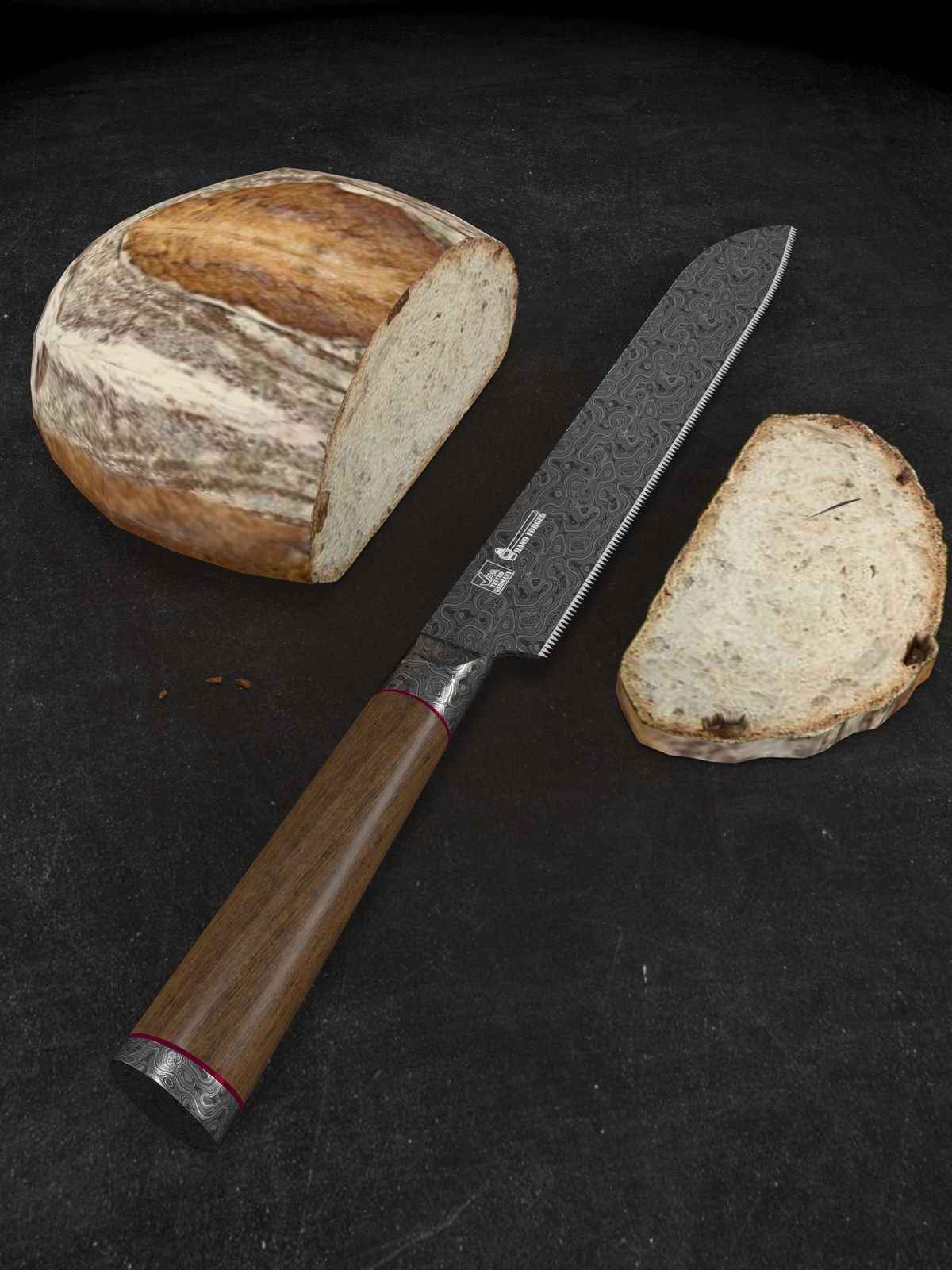
Bread is the obvious reason to own a serrated knife, but it is not the only one. A crisp crust around a soft center benefits from a cutting motion that does not simply press downward. Some other foods with resistant skins or delicate interiors may also suit a serrated edge. The useful question is which of those jobs occurs regularly in your kitchen.
For a loaf, compare blade length with the bread you normally buy. A very short serrated knife may force you to make awkward, repeated movements across a large loaf. You also need a board with enough room for the loaf and your cutting motion.
Let the edge work without crushing
Use a controlled back-and-forth motion appropriate to the knife and food, rather than trying to force the blade straight down. Keep the food stable and your supporting hand clear. A serrated knife is not a solution for a loaf balanced on a plate or a board that slides across the counter.
The shape of the handle matters here, too. Check knuckle clearance and whether the handle allows a comfortable position near the board. An offset design may change that clearance, but it can also change how the knife feels and stores.
Do not assume a bread knife is suitable for every hard ingredient. Frozen food, bones and other demanding tasks may require equipment specifically intended for them. Using the knife outside its purpose can damage it or make the cut difficult to control.
Think about maintenance before a bargain
Serrations need a suitable sharpening approach. A general pull-through sharpener may not be appropriate, and treating the edge like a smooth blade can alter it. Check the manufacturer's guidance or ask a sharpening service what it can maintain.
Store the blade so the teeth are protected and cannot catch someone reaching into a drawer. A guard must fit the actual blade profile; forcing an unsuitable cover onto it is not a storage plan. Wash and dry the knife as directed after use.
If you buy sliced bread and rarely prepare foods that benefit from serration, this purchase may be less urgent than a reliable general-purpose knife. If you regularly cut unsliced loaves, it can save frustration at nearly every breakfast. Frequency, rather than the number of slots in a knife block, is the strongest reason to own one.